Support WhatsApp: +44 785 643-7247
Practical Driving Test Tips to Pass First Time (2026 Complete Guide)

Practical Driving Test
I’ve sat in the passenger seat for hundreds of driving tests over the years, and the pattern is always the same. It’s rarely the learners who can’t drive who fail. It’s the ones who can drive perfectly well but let nerves, sloppy habits, or a misunderstanding of what the examiner is actually looking for get in the way.
This guide is the same brief I give my own pupils the week before their test. No fluff just what actually moves the needle from a near-pass to a genuine first-time pass. theory test pass certificate UK
The Marking System Explained (Minors vs. Majors)
Before anything else, understand exactly how you’re being scored. Most of the anxiety around test day comes from not knowing this. practical driving test pass certificate UK
There are three types of fault:
- Driving fault (minor) — a small mistake that doesn’t create danger. You can rack up to 15 of these and still pass.
- Serious fault (major) — a potentially dangerous mistake, or a minor fault repeated so often it becomes a pattern. One of these fails the test.
- Dangerous fault — an action that causes actual danger to you, the examiner, or anyone else on the road. One of these fails the test immediately.
Quick summary:
- ✅ 0–15 minors, no majors → Pass
- ❌ 16+ minors → Fail
- ❌ 1 serious fault → Fail
- ❌ 1 dangerous fault → Fail
Here’s the bit most learners miss: a wobble is not the same as a fail. Stalling at a junction, hesitating slightly at a roundabout, or a scrappy gear change are minors annoying, but not fatal to your test. What turns a minor into a serious fault is usually the consequence, not the action itself. Stalling is a minor. Stalling and then panicking your way into a junction without checking is serious. how to get theory test certificate UK
The mindset shift that helps most: stop trying to drive a “perfect” test. Aim to drive a safe, competent test. Those are different goals, and the second one is far more achievable.
Pre-Test Prep (Nerves, Paperwork, and the Eye Test)
The test itself starts before you’ve even got in the car. Here’s what to sort in the days before.
Paperwork — don’t let this catch you out:
- Bring your provisional photocard licence
- Bring your theory test pass certificate number if it isn’t already linked
- If your licence is a paper one from Northern Ireland, bring a valid passport too
- No licence, no test the examiner cannot make exceptions on the day, even if it’s clearly just an oversight
The eyesight check happens first, and it’s a hard stop:
- Before you even sit in the car, you’ll be asked to read a number plate from 20 metres
- Glasses or contact lenses are absolutely fine wear them if you normally do
- Fail this, and the test ends before it starts. Practise this specific check in the week before, not just general eyesight it’s the exact distance that matters how to get practical test certificate UK
The night before:
- Get a proper night’s sleep. Tired driving looks nervous driving to an examiner, even if you’re technically fine lost theory test pass certificate
- Eat something before you leave. A shaky, hungry learner makes more observation mistakes, not fewer
- Lay out your documents the night before so the morning isn’t a scramble
On the day:
- Arrive 10–15 minutes early not more. Sitting in a car park for 45 minutes overthinking helps nobody
- Wear flat, comfortable shoes you can actually feel the pedals in. Chunky trainers or heels are the single most avoidable own-goal I see
- Do your final vehicle checks mirrors adjusted, seatbelt on, seat position right calmly, before the examiner even gets in lost practical test pass certificate
On managing nerves specifically: the single best trick I give pupils is to talk yourself through your first few actions out loud in your head, exactly like you’ve practised a hundred times in lessons. The test is deliberately designed to look and feel like an ordinary lesson drive. Treat it as one.
The Driving Secrets (Exaggerating Mirror Checks and Managing Mistakes)
This is where a genuinely capable driver either confirms it to the examiner or accidentally looks less safe than they actually are.
Make your observations obvious. Examiners can’t read your mind. If you check a mirror but don’t visibly move your head or eyes, they have no way of marking it as an observation. Slightly exaggerate every mirror check and shoulder look not dramatically, just enough that it’s unmistakably deliberate. This alone prevents a huge number of “lack of observation” minors and majors that are actually just observations the examiner couldn’t see. replace lost theory test certificate
Drive like you would with your instructor, not like you think an examiner wants. The test is marked against normal, safe driving — not textbook-perfect robotic driving. Over-hesitating at every junction to “be careful” often creates more faults than it prevents, because indecision itself gets marked. replace lost practical test certificate
Recovering from a mistake is more important than the mistake itself. Stalled at the lights? Fine pause, calmly restart, check your mirrors, move off when safe. What fails people isn’t the stall. It’s panicking afterwards and pulling away without checking, or freezing and creating a hazard behind you.
Quick recovery checklist for common slip-ups:
- Stalled the car? Handbrake on, clutch down, restart calmly, check mirrors before moving off
- Missed a turn? Keep driving normally and follow the examiner’s next instruction you will not be penalised for missing a sat-nav turn itself find theory test pass number
- Went too slow through a section? Gradually bring your speed up to the appropriate limit; don’t panic-accelerate
- Not sure if you did something wrong? Keep driving. Dwelling on a mistake mid-test causes the next mistake
Speed control and lane discipline matter more than examiners let on. Sitting 5mph under the limit “to be safe” is actually marked as a fault in some contexts examiners are checking you can drive at a normal, appropriate progress, not a nervous crawl. theory test certificate number UK
Conquering the Manoeuvres & Independent Driving
The manoeuvres you’ll be asked to do one:
- Parallel parking reference points matter more than speed; go slowly and check all-round observation constantly
- Forward bay parking precision beats speed here; a slightly wonky but safe attempt beats a fast, careless one theory test pass certificate online
- Reverse bay parking mirror and blind-spot checks throughout, not just at the start
- Pulling up on the right indicate, check your mirrors and blind spot thoroughly before pulling in, and again before moving off
- Emergency stop still part of the test; react promptly and firmly to the signal, keep full control, no skidding
The independent driving section 20 minutes of the test:
- You’ll follow a sat-nav, road signs, or a mix of both
- Taking a wrong turn is not an automatic fault. If you miss a turn, simply keep driving safely and let the examiner redirect you
- Staying calm here matters more than getting the route exactly right examiners are watching your decision-making under mild pressure, not your navigation skills
Show Me, Tell Me questions — worth two easy marks:
- One “tell me” question is asked before you start driving; one “show me” question is asked while you’re driving
- These are drawn from the official DVSA vehicle safety question bank
- Getting one wrong is only a minor fault — don’t guess randomly under pressure, take a breath and answer what you genuinely know
- Practise these out loud in the week before, using the actual car you’re testing in, so the controls are familiar under your fingers
Final insider tip: examiners aren’t trying to catch you out. Every question, manoeuvre, and instruction on test day is something you’ve already done dozens of times in lessons. The test isn’t testing anything new — it’s confirming what you already know how to do.
Frequently Asked Questions
How many minors can you get? You can have up to 15 driving faults (minors) and still pass, as long as you don’t pick up any serious or dangerous faults along the way.
Can you pass with 15 minors? Yes — 15 minors is the maximum and still counts as a pass, provided there are no serious or dangerous faults. 16 or more minors results in a fail.
What is an automatic fail? A single serious fault or a single dangerous fault results in an automatic fail, regardless of how well the rest of the test went.
Can you talk to the examiner? Yes, briefly. A simple “good morning” or asking a quick question is fine — examiners aren’t there to catch you out through conversation, but heavy chat can distract your concentration.
Is the emergency stop still in the test? Yes, it remains part of the practical test. Not every candidate will be asked to perform it on every test, but it is still an active part of the assessment.
What happens if I stall? Stalling on its own is a minor fault. It only becomes serious if you react badly afterwards, such as pulling away without checking your mirrors properly.
Do examiners try to trick you? No. Every task on test day reflects normal driving situations you’ve already practised. Examiners assess safe, competent driving — not textbook perfection.
Can I use my own car? Yes, provided it meets the DVSA’s vehicle requirements, including valid tax, MOT, insurance for test purposes, and L-plates displayed correctly.
Internal Linking Suggestions
- Theory Test Booking Guide
- Practical Test Booking Guide
- Driving Test Nerves and Confidence Tips
- Intensive Driving Courses Guide
- Step-by-Step Guide to Getting a UK Driving Licence
- First-Time Driver Advice
External Linking Suggestions (GOV.UK / DVSA only)
- GOV.UK: Book your practical driving test
- GOV.UK: What happens during your driving test
- GOV.UK: Show me, tell me vehicle safety questions
- GOV.UK: Reasons for failing your driving test
Image Suggestions & ALT Text
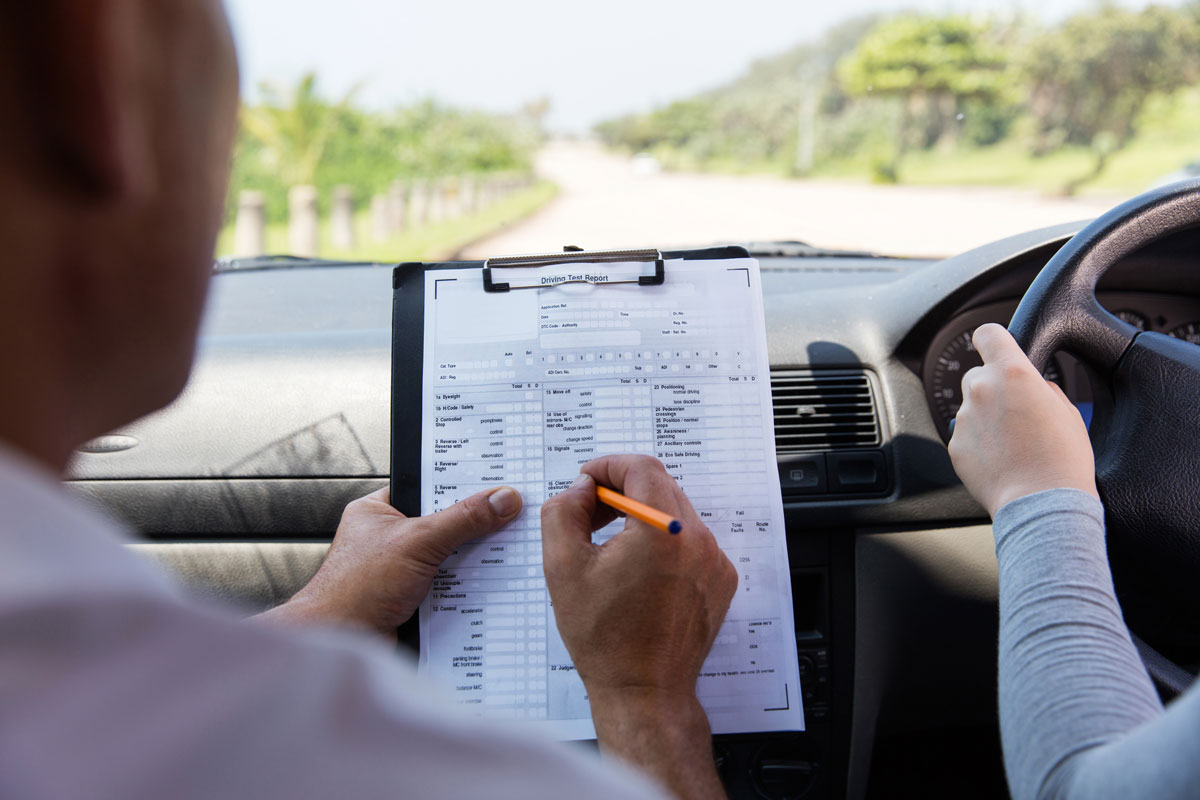
- Learner driver gripping the wheel with an examiner in the passenger seat — ALT: “UK practical driving test with examiner”
- Close-up of a car’s wing mirror during a manoeuvre — ALT: “Mirror check during driving test manoeuvre”
- Sat-nav mounted on a car dashboard — ALT: “Following sat-nav during independent driving test section”
- Learner driver smiling after passing test, holding pass certificate — ALT: “Passing UK driving test first time”