Support WhatsApp: +44 785 643-7247
cost of getting a full UK driving licence
Learning to drive is one of those milestones that’s exciting right up until you sit down and add up what it’s actually going to cost. Between the provisional licence, the theory test, dozens of driving lessons, and the practical test itself, it’s easy to see why so many families end up quietly wondering: how much is this really going to be?
This guide breaks down every official fee, every realistic lesson cost, and every hidden expense that catches learners out, so you can budget properly from day one rather than being surprised halfway through. Whether you’re a learner saving up from a part-time job, a parent helping fund lessons, or an expat working out what a UK test will cost on top of your existing licence, you’ll find a clear, honest cost picture here. provisional licence
Official DVLA and DVSA Fees in 2026
These are the fixed government fees you can’t negotiate or shop around for — they’re set centrally and are the same no matter which instructor or driving school you use.
| Service | Official 2026 Fee | Notes |
|---|---|---|
| Provisional Driving Licence (Online) | £34 | Apply through GOV.UK |
| Provisional Driving Licence (By Post) | £43 | Paper D1 application |
| Theory Test | £23 | Covers both multiple-choice and hazard perception sections |
| Practical Driving Test (Weekday) | £62 | Standard weekday appointment |
| Practical Driving Test (Evening/Weekend/Bank Holiday) | £75 | Higher demand slots |
| Replacement Licence | £20 | If lost, stolen or damaged |
| Licence Renewal (photocard, every 10 years) | £14 online / £17 by post | Applies once you already hold a full licence |
A few things worth knowing about each of these:
- The provisional licence fee is a one-off payment covering your initial application. It doesn’t need renewing again until your photocard reaches its 10-year expiry.
- The theory test fee covers both parts of the test the 50-question multiple-choice section and the 14-clip hazard perception section in a single sitting. If you fail either part, you pay the full £23 again to rebook.
- The practical test fee varies depending on when you book. Weekday daytime slots are cheaper than evening, weekend, or bank holiday appointments, which are in higher demand.
These fees are set by the DVSA and DVLA and are reviewed periodically, so always check the current rate directly on GOV.UK before paying, particularly if you’re reading this some time after publication.
Full Breakdown of Every Cost
Provisional Licence
As above, this is £34 online or £43 by post — a single upfront cost that unlocks everything else in the process.
Theory Test
£23 per attempt, covering both sections. Many learners also spend a little on revision materials, covered separately below.
Driving Lessons
This is by far the biggest cost in the entire process, and where most of your budget will go. More detail on this in the dedicated section further down.
Learner Insurance
If you’re practising in a family car rather than exclusively taking lessons in your instructor’s vehicle, you’ll usually need to be added to the insurance as a learner driver, or take out a short-term learner policy. This varies enormously depending on your age, location, and the car itself.
Study Materials
Most learners spend a small amount on a theory test app or a Highway Code book, and this is genuinely worth budgeting for, since the alternative is often failing your first attempt and paying £23 again.
Practical Test
£62 on weekdays or £75 on evenings/weekends, as above. Remember that a fail means paying this fee again, plus a mandatory 10 working day wait before rebooking.
Additional Expenses
- Fuel for private practice sessions
- Possible extra lessons if you need longer than expected to reach test standard
- A mock test with your instructor before the real thing
- Time off work or school for lessons and test appointments
How Much Do Driving Lessons Cost?
This is where most of your money goes, and where prices vary the most depending on who you learn with.
Independent Instructors
Independent, self-employed instructors often charge somewhere in the £30–£40 per hour range, and many offer discounted block bookings if you pay for multiple lessons upfront.
Driving Schools
Larger, branded driving schools sometimes charge slightly more per hour than independent instructors, though this can vary by region and by which specific instructor you’re assigned.
Intensive Courses
Intensive (or “crash”) courses condense weeks of lessons into a few consecutive days, often costing more overall per hour of tuition due to the concentrated scheduling, but potentially saving money in total if they help you avoid a long, drawn-out learning period with lapsed skills between lessons. These suit confident learners rather than complete beginners.
Manual vs Automatic Lessons
Automatic lessons are sometimes priced similarly to manual ones, though instructor availability for automatic cars can be more limited in some areas, which occasionally pushes prices up slightly due to lower supply. UK driving licence cost
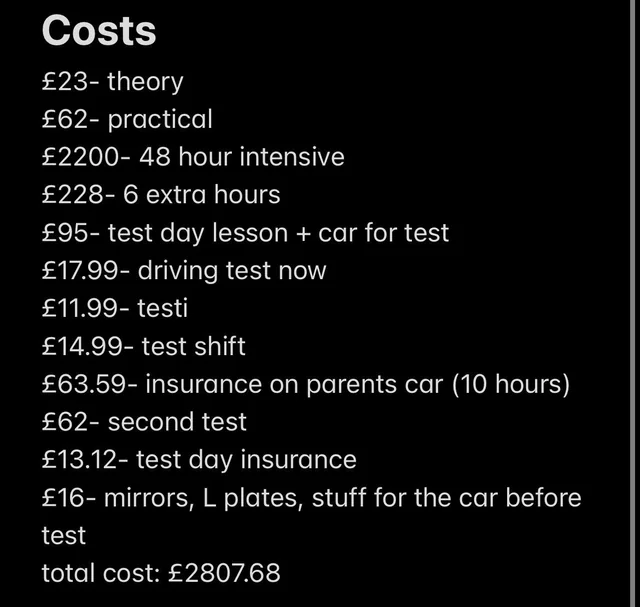
Estimated Total Cost to Get a Full Licence
Based on the DVSA’s recommended 45 hours of professional lessons, here’s a realistic cost breakdown using an average lesson price of £35–£40 per hour.
| Expense | Estimated Cost |
|---|---|
| Provisional Licence | £34 |
| Theory Test | £23 |
| Practical Test (weekday) | £62 |
| 45 Hours Driving Lessons (£35/hour) | £1,575 |
| 45 Hours Driving Lessons (£40/hour) | £1,800 |
| Theory Test App | £5–£15 |
| Highway Code Book | £10–£20 |
| Learner Driver Insurance (private practice) | £200–£800 |
| Additional Mock Test | £40–£80 |
| Fuel for Private Practice | £60–£150 |
| Total Estimated Cost | £2,000–£2,900 |
Budget Learner
If you rely mostly on private practice with a family member, pass your theory and practical tests first time, and skip extras like a mock test, you could realistically come in closer to £1,700–£2,000 in total.
Average Learner
Most learners land somewhere in the £2,000–£2,600 range, combining professional lessons with a reasonable amount of private practice, and passing within one or two attempts at each test.
Higher-Cost Learner
If you need extra lessons beyond the recommended 45 hours, fail either test once (or more), or rely entirely on paid lessons without private practice, your total could climb toward £2,800–£3,500 or more.
Why Costs Vary Across the UK
Lesson prices tend to be higher in London and the South East compared to more rural areas or parts of the North, largely reflecting differences in instructor overheads and local demand. Test centre waiting times also vary regionally, and longer waits can mean more lessons needed just to stay in practice, indirectly pushing up your total cost. driving licence fees UK
Hidden Costs Many Learners Forget
- Extra lessons beyond your original plan. Very few learners hit test standard in exactly 45 hours — treat that figure as a guide, not a guarantee.
- Retest fees. A fail means paying the full test fee again, on top of the 10 working day mandatory wait.
- Fuel for private practice. This adds up faster than most learners expect, especially with longer sessions.
- Time off work or school. Lessons and tests are usually scheduled during the day, which can mean lost income or unpaid leave for older learners.
- Insurance excess or premium increases. If you’re added to a family car’s insurance as a learner, this can raise the overall premium, not just add a flat fee.
- Instructor’s car fee on test day. Some instructors charge a small additional fee for use of their dual-control car on your actual test day, on top of your lesson costs.
How to Save Money While Learning to Drive
- Practise with a qualified family member where possible, to reduce the number of paid lessons you need. They must be at least 21 and have held a full licence for the relevant category for at least three years.
- Buy lesson packages or block bookings. Many instructors offer a discounted rate per hour when you commit to a block of ten or more lessons upfront.
- Aim to pass first time. Retaking either test doesn’t just cost the test fee again — it usually means paying for extra lessons in the meantime too.
- Compare instructor prices before committing. Prices vary more than people expect even within the same town, so it’s worth getting a few quotes.
- Practise consistently rather than sporadically. Regular, frequent lessons tend to need fewer total hours than lessons spread thinly over many months, since skills don’t fade between sessions.
- Use free or low-cost theory resources. The official DVSA app and free online mock tests can reduce or remove the need to buy expensive revision bundles.
- Book your tests as early as your instructor recommends. Waiting lists can be long in some areas, and delaying your booking often means paying for extra “maintenance” lessons just to stay sharp before the test.
- Avoid unnecessary retests. Only book your practical test once your instructor genuinely confirms you’re at a consistent test standard, rather than booking speculatively and hoping for the best. dvla driving licence application taking too long
Conclusion
The realistic cost of getting a full UK driving licence in 2026 typically falls somewhere between £2,000 and £2,900 for most learners, once you account for official DVLA and DVSA fees, lessons, insurance, and study materials. Your own total will depend heavily on how many lessons you need, whether you pass first time, and how much private practice you’re able to fit in alongside paid tuition.
The best way to keep costs under control is simple: practise consistently, use free revision resources, and only book each test once you’re genuinely ready. Budgeting properly from the start makes the whole process far less stressful and gets you to that full licence with fewer financial surprises along the way. dvla driving licence contact phone number
Frequently Asked Questions
How much does it cost to get a full UK driving licence? Most learners spend between £2,000 and £2,900 in total, covering the provisional licence, theory test, practical test, roughly 45 hours of lessons, and study materials. Costs vary depending on region, instructor rates, and how many attempts each test takes.
How much are driving lessons? Driving lessons typically cost around £35–£40 per hour with independent instructors or driving schools. Prices vary by region, with London and the South East generally more expensive than other parts of the UK.
Is learner insurance worth it? If you’re practising in a family car outside of paid lessons, learner insurance (or being added as a named learner driver) is legally required. It adds to your overall costs but allows valuable extra practice hours between paid lessons.
What is the cheapest way to learn to drive? Combining a smaller number of professional lessons with consistent private practice, supervised by a qualified family member aged 21 or over, tends to be the most cost-effective route, provided you pass both tests first time.
Can I pass with fewer than 45 lessons? Yes, 45 hours is only a DVSA recommendation, not a requirement. Some learners with prior experience or strong natural ability reach test standard sooner, while others need more time.
How much does a practical driving test cost? The practical test costs £62 on weekdays and £75 for evening, weekend, or bank holiday appointments. A failed test means paying the full fee again to rebook, alongside a mandatory 10 working day wait.
What happens if I fail my test? You’ll need to wait at least 10 working days before rebooking, and you’ll pay the full test fee again. Many learners also book a few extra lessons in this period to address the specific faults raised.
Are automatic lessons more expensive? Not always, though limited instructor availability for automatic cars in some areas can occasionally push prices up slightly compared to manual lessons, simply due to lower local supply.
Can I learn with a family member? Yes, as long as they’re at least 21 years old and have held a full licence for the relevant vehicle category for at least three years. This can meaningfully reduce how many paid lessons you need.
Do driving lesson prices vary across the UK? Yes, quite significantly. Lessons in London and the South East tend to cost more than in rural areas or parts of the North, largely reflecting differences in instructor overheads and local demand.