Support WhatsApp: +44 785 643-7247
If you’ve started looking into learning to drive, you’ve probably seen the term “full UK driving licence” mentioned everywhere on insurance forms, job applications, car rental sites, and DVLA guidance pages. But what does it actually mean, and how is it different from the provisional licence you start out with? is my uk driving licence photocard still valid
This guide answers that question in plain English. We’ll cover what a full UK driving licence actually is, who’s eligible to get one, and the complete step-by-step process from your very first provisional application through to passing your practical test and receiving your photocard licence in the post. We’ll also look at costs, common delays, and what expats and international drivers need to know.
By the end, you should have a clear picture of exactly where you are in the process and what’s left to do.
What Is a Full UK Driving Licence?
Definition
A full UK driving licence is the official document issued by the DVLA (Driver and Vehicle Licensing Agency) that confirms you’ve met all the legal requirements to drive unsupervised on public roads. It’s the end result of the learning process: you apply for a provisional licence, pass your theory test, learn to drive, pass your practical test, and the DVLA then upgrades your record so you hold a full licence rather than a provisional one. what does my uk driving licence number mean
The DVLA is the government agency responsible for maintaining driver records, issuing licences, and registering vehicles in Great Britain. Northern Ireland has its own equivalent, the DVA.
What Vehicles Can You Drive?
A full car licence (category B) allows you to drive:
- Cars and small vans up to 3,500kg
- Vehicles with up to eight passenger seats
- A vehicle with a trailer, within certain weight limits
If you want to ride motorcycles, drive a minibus, or operate larger goods vehicles, you’ll need additional categories added to your licence, each with its own test requirements. Most new drivers start with category B, which is what this guide focuses on. where is the expiry date on uk driving licence
Difference Between a Provisional Licence and a Full Licence
It’s easy to mix these two up when you’re just starting out, so here’s a side-by-side comparison.
| Feature | Provisional Licence | Full Licence |
|---|---|---|
| Can you drive unsupervised? | No | Yes |
| Do you need L-plates? | Yes | No |
| Can you drive on motorways alone? | No | Yes |
| Supervision required? | Yes, by a qualified driver aged 21+ | No |
| Valid for | Learning and taking tests | Full legal driving |
| Issued after | Application only | Passing theory and practical tests |
| Photocard validity | 10 years | 10 years |
The core difference is simple: a provisional licence lets you learn, while a full licence lets you drive independently, without supervision and without L-plates.
Who Can Apply for a Full UK Driving Licence?
You don’t apply for a full licence directly it’s issued automatically once you pass your practical test. But to get to that point, you need to meet several eligibility rules from the very start. what do the codes on uk driving licence stand for
Age Requirements
You can apply for a provisional licence once you’re 15 years and 9 months old, but you can’t legally drive a car on public roads until you turn 17. There’s an exception for some people who receive the higher rate of the mobility component of Disability Living Allowance or Personal Independence Payment, who can drive from age 16.
Residency Requirements
To hold a GB driving licence, you normally need to be a resident of Great Britain. If you’re a new resident from overseas, there are separate rules depending on where your existing licence was issued, which we’ll cover later in the expat section.
Medical Requirements
You must declare any medical condition that could affect your driving, including epilepsy, certain heart conditions, diabetes treated with insulin, and some visual impairments. Failing to declare a relevant condition is a legal offence, and the DVLA may ask for a medical report before deciding whether you can hold a licence.
Eyesight Requirements
You must be able to read a car number plate made after September 2001 from 20 metres away, with glasses or contact lenses if you need them. This is checked at the very start of your practical test, and failing it means an immediate end to the test.
Step 1 – Apply for a Provisional Licence
Everything starts here. Without a provisional licence, you can’t take lessons, sit your theory test, or book your practical test.
Eligibility
As above, you need to be at least 15 years and 9 months old and normally resident in Great Britain.
Required Documents
To apply, you’ll typically need:
- A valid UK passport, or another acceptable form of identity document
- Your National Insurance number, if you know it
- All addresses you’ve lived at over the last three years
- A passport-style digital photo (unless using your passport photo)
- A debit or credit card, if applying online
Application Process
Most people apply online through GOV.UK, which usually takes around 20 minutes. If you don’t have a valid passport, you’ll need to complete a paper D1 form, available from Post Office branches, and post it along with original identity documents. can i drive while waiting for my new uk licence
Online applications are generally processed faster, with the licence typically arriving within about a week once your identity is verified. Postal applications take longer, often up to three weeks, because DVLA staff need to manually check the physical documents.
DVLA Fees
- Online application: £34
- Postal application: £43
- Replacement (lost, stolen or damaged): £20
- Renewal after 10 years: £14 online, £17 by post
These are the standard DVLA fees at the time of writing, but always check the current rate on GOV.UK before paying, since fees are reviewed periodically.
Step 2 – Pass the Theory Test
Once your provisional licence arrives, you’re free to book your theory test. You don’t need to wait until you’ve finished lessons to do this — many learners study for it while lessons are ongoing.
Multiple-Choice Section
This section presents 50 questions covering road signs, hazard awareness, vehicle safety, and rules from the Highway Code. You need at least 43 correct answers to pass this part.
Hazard Perception
This is the part that catches a lot of learners off guard if they haven’t practised it. You’re shown 14 video clips filmed from a driver’s point of view, each containing at least one developing hazard — something that starts as a minor risk and could turn into a real danger, like a pedestrian stepping toward the kerb or a car pulling out from a side road.
You click your mouse as soon as you spot the hazard developing. The earlier you spot it (without clicking randomly, which can be flagged as cheating the system), the more points you score. You need a minimum combined score to pass this section.
Pass Marks
You must pass both the multiple-choice section (43 out of 50) and the hazard perception section (typically 44 out of 75) in the same sitting. Passing one but not the other means you need to retake the whole test.
Common Mistakes
- Memorising question banks instead of genuinely understanding the Highway Code
- Clicking too early or too often during hazard perception clips
- Rushing through multiple-choice questions without reading them properly
- Not revising updated road signs or newer Highway Code rules
How Long the Theory Pass Lasts
Your theory test certificate is valid for two years. If you haven’t passed your practical test within that window, you’ll need to sit and pass the theory test again before you can book another practical test.
Step 3 – Learn to Drive
This is usually the longest stage of the whole process, and rightly so it’s where you build the actual skills you’ll rely on for the rest of your driving life.
Driving Lessons
Most learners take lessons with an approved driving instructor (look for the ADI badge displayed in the windscreen). The DVSA recommends around 45 hours of professional lessons for the average learner, though this varies hugely depending on prior experience and natural ability.
Private Practice
Alongside lessons, many learners also practise privately in a family or friend’s car. To supervise a learner, the person must be at least 21 years old and have held a full licence for the relevant vehicle category for at least three years. The car must clearly display L-plates on the front and back.
The DVSA also recommends around 22 hours of private practice on top of professional lessons, giving a rough combined total of 67 hours before most learners reach test standard.
Skills Required
Before booking your practical test, you should be comfortable with:
- Moving off and stopping safely
- Clutch control and gear changes (for manual cars)
- Roundabouts, junctions, and lane discipline
- Reversing manoeuvres, including parallel parking
- Reading the road and anticipating hazards
- Independent driving using sat-nav directions or road signs
Step 4 – Pass the Practical Driving Test
This is the final hurdle before your full licence is issued.
Booking the Test
You book directly through GOV.UK once your instructor feels you’re ready. Availability varies by region busy urban test centres can have longer waits than rural ones, so it’s worth checking for cancellations regularly, as slots often open up sooner than the standard booking calendar suggests.
What Happens on Test Day
- An eyesight check, reading a number plate from 20 metres
- “Show me, tell me” vehicle safety questions
- General driving in a mix of road and traffic conditions
- Independent driving for around 20 minutes, following sat-nav or road signs
- One or more manoeuvres, such as reverse parking or a parallel park
- The result, given immediately by the examiner
The whole test takes around 40 minutes.
Driving Faults Explained
The DVSA records three types of faults during your test:
- Minor faults: Small errors that don’t affect safety. You can have up to 15 of these and still pass.
- Serious faults: A potentially dangerous error. Even one of these results in a fail.
- Dangerous faults: An error that caused actual danger to yourself, the examiner, or others. This also results in an automatic fail.
Reasons People Fail
The most common fail points, year after year, tend to be:
- Poor observation at junctions
- Not checking mirrors before signalling or changing direction
- Incorrect positioning or lane discipline on roundabouts
- Losing control during reverse parking manoeuvres
- Not responding appropriately to pedestrians or cyclists
How to Improve Your Chances of Passing
- Don’t book your test until your instructor confirms you’re consistently at test standard
- Practise on a wide range of road types, not just routes near home
- Do a mock test shortly before the real one
- Get a full night’s sleep and arrive with plenty of time to spare
What Happens After You Pass?
Receiving Your Full Licence
If you pass, the examiner gives you a pass certificate on the spot, and you’re legally allowed to drive unsupervised immediately, without L-plates, as long as you’re insured. In most cases, the DVLA automatically links your pass to your provisional record and issues your new full photocard licence without you needing to apply separately.
How Long DVLA Takes
Your new full photocard licence usually arrives within a few weeks. If it hasn’t turned up after three weeks, it’s worth contacting the DVLA directly to check on the status of your application.
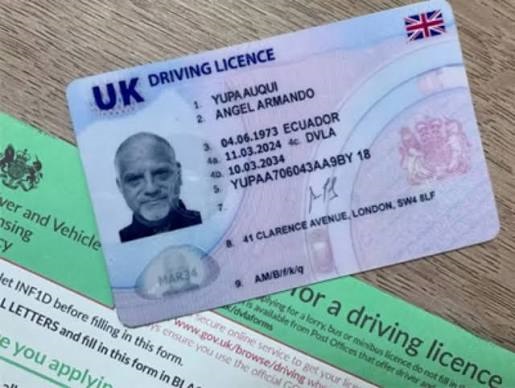
Photocard Licence
Your photocard is valid for 10 years and needs renewing periodically, along with your photo. It’s a legal requirement to keep your address updated on your licence, so remember to notify the DVLA if you move house.
DVLA Requirements
A few things the DVLA checks and enforces throughout the whole process:
- Identity verification: Confirmed against passport or other accepted ID during your provisional application
- Address verification: Cross-checked against your submitted address history
- Medical declarations: Any relevant condition must be declared honestly and promptly
- Eyesight standards: Checked at your practical test and self-declared on application
- Licence categories: Determine which vehicles you’re legally allowed to drive
- Penalty points: Accumulated points can lead to fines, restrictions, or disqualification
- Driving bans: New drivers who reach six or more penalty points within two years of passing have their licence automatically revoked under the New Drivers Act, and must reapply as a learner and retake both tests
Costs of Getting a Full UK Driving Licence
| Item | Approximate Cost |
|---|---|
| Provisional licence (online) | £33 |
| Provisional licence (post) | £43 |
| Theory test | £23 |
| Practical test (weekday) | £62 |
| Practical test (evening/weekend) | £75 |
| Driving lessons (average, ~45 hours) | £1,575–£1,800 |
| Learner insurance for private practice | £100–£300 |
| Estimated total (first-time pass) | £1,800–£2,300 |
These figures are widely reported estimates based on current DVLA and DVSA fees and typical instructor rates. Always check GOV.UK for the most current official fees, since these are reviewed and adjusted periodically.
Can Expats Get a Full UK Driving Licence?
Foreign Licence Rules
If you’re new to the UK, whether you can carry on driving with your existing licence and for how long depends on where it was issued.
- EU/EEA licences: These can usually be exchanged for a UK licence without needing to take any tests, as long as the exchange happens within a set period after becoming a UK resident.
- Designated country licences: The UK has agreements with certain non-EU countries (including places like Australia, Canada, Japan, and South Korea) that allow licence holders to exchange their licence for a UK one without retesting, again within a set timeframe.
- Other countries: If your licence isn’t from an EU/EEA or designated country, you’ll typically need to apply for a provisional licence and pass both the UK theory and practical tests, just like a first-time learner.
When UK Tests Are Required
Generally, UK tests are required if:
- Your home country doesn’t have a licence exchange agreement with the UK
- Your temporary driving permission period (usually 12 months as a visitor or new resident) has expired
- You want to add a category not covered by your current licence
Because rules for licence exchange change periodically and depend heavily on your country of origin, it’s always worth checking the current GOV.UK guidance for your specific situation rather than relying on general advice.
Common Reasons Applications Are Delayed
- Incorrect or incomplete forms: Missing signatures or incorrect details are one of the most common causes of delay
- Medical investigations: If you’ve declared a relevant condition, the DVLA may need extra time to request reports from your doctor or specialist
- Identity issues: Documents that don’t match across your application (e.g., a change of name not yet reflected in your passport) can hold things up
- DVLA processing backlogs: Occasionally, high application volumes lead to longer-than-usual waits, particularly for postal applications
Tips to Get Your Licence Faster
- Apply for your provisional licence online rather than by post wherever possible
- Start studying for your theory test while you’re still taking early driving lessons
- Book lessons regularly and consistently, rather than sporadically over several months
- Consider an intensive course if you already have some driving confidence
- Keep an eye on test centre cancellations, which often appear sooner than standard bookings
- Do a mock practical test with your instructor before booking the real thing
Common Mistakes to Avoid
- Driving before your provisional licence has actually arrived
- Practising with a supervisor who doesn’t meet the age or experience requirement
- Forgetting to display L-plates during lessons or private practice
- Booking your practical test before you’re consistently at test standard
- Not revising the Highway Code properly for the theory test
- Clicking too often during the hazard perception clips
- Letting your theory pass expire before booking a practical test
- Failing to declare a relevant medical condition
- Not updating your address with the DVLA after moving house
- Assuming a foreign licence automatically qualifies for UK exchange without checking eligibility
Conclusion
Getting a full UK driving licence is a step-by-step process: apply for your provisional licence, pass your theory test, build your driving skills through lessons and practice, and finally pass your practical test. Each stage has its own requirements, costs, and potential pitfalls, but none of them are complicated once you know what to expect.
If you’re just starting out, the best first move is simple: apply for your provisional licence and start studying for your theory test. Everything else follows naturally from there.
Frequently Asked Questions
What is a full UK driving licence? A full UK driving licence is the official document issued by the DVLA confirming you’ve passed both the theory and practical driving tests. It allows you to drive unsupervised, without L-plates, within the categories shown on your licence.
How do I get a full UK driving licence? Apply for a provisional licence, pass your theory test, learn to drive through lessons and practice, then pass your practical test. Once you pass, the DVLA automatically upgrades your provisional record to a full licence.
How long does it take to get a full UK driving licence? Most learners take between three and twelve months from applying for their provisional licence to passing their practical test, depending on lesson frequency, test availability, and how quickly they pass their theory test.
How much does it cost to get a full UK driving licence? Expect to pay around £1,800–£2,300 in total, covering the provisional licence, theory test, practical test, and roughly 45 hours of driving lessons. Costs vary by region and instructor rates.
Can I drive alone with a provisional licence? No. A provisional licence only allows supervised driving with L-plates displayed and a qualified supervisor present. You can only drive unsupervised once you’ve passed your practical test.
What documents do I need to apply? You’ll typically need a valid passport (or other accepted ID), your National Insurance number, three years of address history, and a passport-style photo, along with payment for the application fee.
How long is the theory test valid? Your theory test pass certificate is valid for two years. If you haven’t passed your practical test within that time, you’ll need to retake and pass the theory test again before booking another practical test.
When will my full licence arrive? Most new full photocard licences arrive within a few weeks of passing your practical test. If it hasn’t arrived after three weeks, contact the DVLA to check the status of your application.
Can foreigners get a UK driving licence? Yes. EU/EEA and certain designated country licence holders can usually exchange their existing licence without retesting, within a set timeframe. Other licence holders generally need to pass the UK theory and practical tests.
What happens if I fail my practical test? You must wait at least 10 working days before retaking the test, and you’ll need to pay the test fee again. Use the examiner’s feedback to focus your practice on the specific faults identified.
Can I drive while waiting for my DVLA licence? You can drive as soon as you pass your practical test, using your pass certificate as proof, even before your new photocard arrives, as long as you’re properly insured.
What medical conditions must be declared? You must declare conditions that could affect your driving, including epilepsy, certain heart conditions, insulin-treated diabetes, and some visual impairments. The DVLA may request a medical report before confirming your licence.